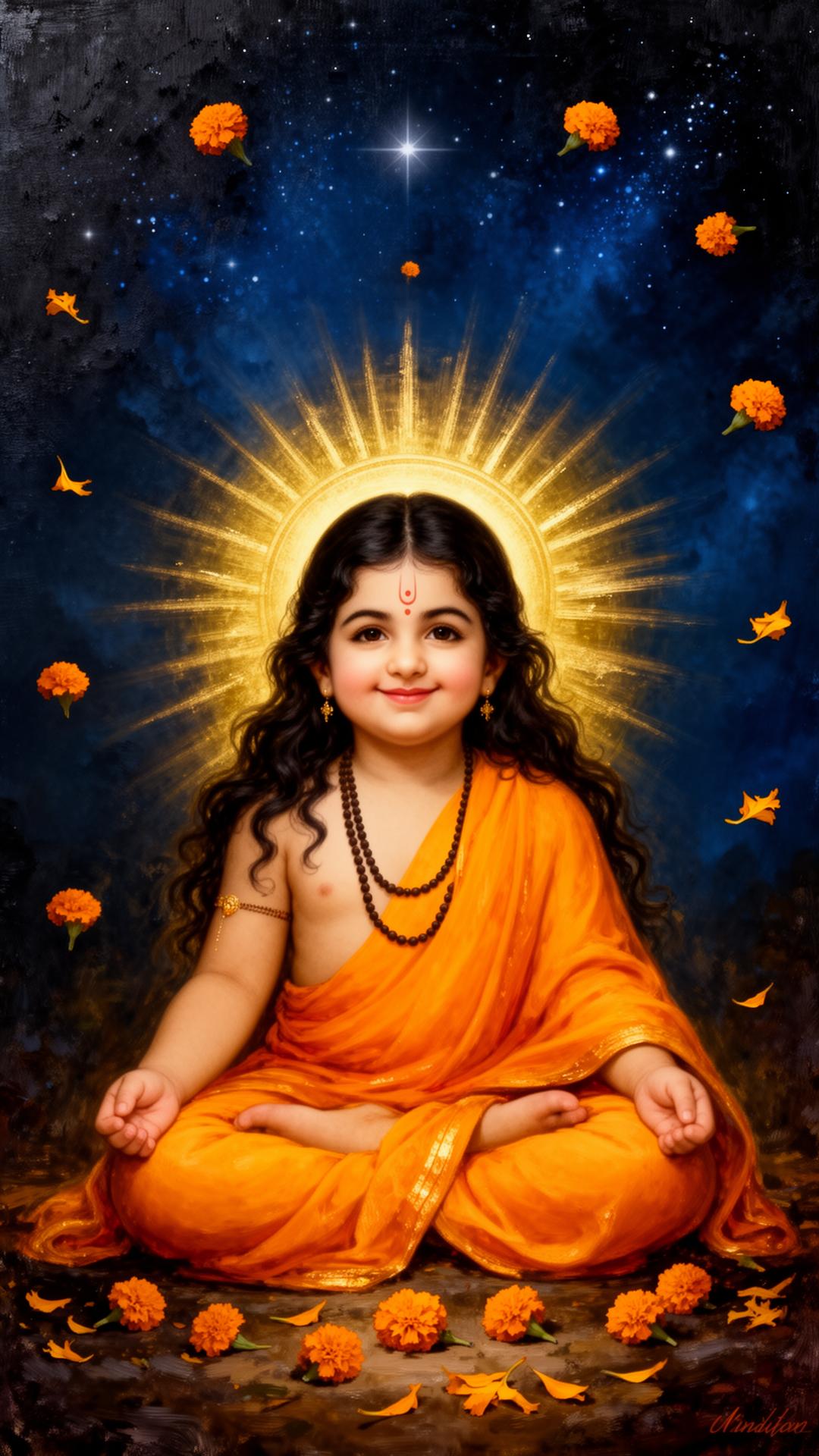
The Bowl of Lassi
At Shah Talai, the simple offering of buttermilk from Mata Ratno was multiplied to feed all who came — a sign that grace flows from sincerity, not abundance.
From a luminous seed within the cosmic order to the silent cave of Deotsidh — the eternal child-yogi whose presence still breathes through the Himalayan hills.
ॐ बाबा बालक नाथ जी की जय
Jai Baba Balak Nath
We begin with this invocation — an offering of reverence before recounting the sacred life of one whose presence is felt, not merely remembered.
Before the breath of His earthly form, before the mountains knew His footstep, Baba Balak Nath Ji existed as a luminous seed within the cosmic order — not born of woman, but expressed by the Divine to walk among mortals as a child who never ages.
The sages speak of Him as Skanda's companion, as a fragment of Shiva's own radiance, taking the form of an eternal balak — a child — so that even the most innocent heart might recognise the Divine in something familiar.
In this way His arrival was not an event in time, but a continuation. He came as one already returning, already remembered by the rivers and the wind.
He is said to have first appeared in Junagadh, in the kingdom of Gujarat, born to Bhagat Vaishno and Lakshmi — pious souls who had prayed long for a son. From the moment of His birth, the child showed no interest in the play of children; His eyes searched the horizon as if remembering another home.
By the age of five He had left the household, drawn northward toward the great mountains. He passed through villages as a wandering balak-yogi, refusing nothing, asking nothing, His presence quietly transforming all who fed Him or listened to His silence.
Each step took Him closer to the cave that had been waiting for Him since the foundations of the world.
In the rugged hills of what is now Hamirpur, Himachal Pradesh, He chose a cave at Deotsidh as His seat of tapasya. Here He sat in stillness for what devotees say were ages beyond reckoning — His breath measured by the slow rhythm of the mountain itself.
The cave became charged with His sadhana: a place where even ordinary stone began to remember the Divine. Pilgrims who reach Deotsidh today speak of the unmistakable quiet that settles upon them as they approach — a hush that is not absence, but presence.
It is from this cave that His blessing radiates still.
"In Mata Ratno's story, we see that devotion does not require learning, wealth, or status — only sincerity of heart."From the Shah Talai Tradition
Three remembered moments, among countless others held in devotee hearts.
At Shah Talai, the simple offering of buttermilk from Mata Ratno was multiplied to feed all who came — a sign that grace flows from sincerity, not abundance.
When falsely accused of losing cattle, the young Baba lifted His hand — and the herd appeared from beneath the earth, undisturbed and well-fed.
Devotees across centuries have spoken of fragrant breezes, unseen footsteps, and prayers answered within hours — the cave at Deotsidh breathes still with His presence.
To stand before Baba Ji is not to perform a ritual but to remember a relationship. Many come with petitions; many leave with something gentler — a quiet certainty that they have been seen.
The cave at Deotsidh is open year-round, with pilgrim seasons swelling around Holi and the Chet mela. Offerings are simple by tradition: rot (a thick wheat bread), milk, and a kindled lamp. Footwear is removed; speech is softened; the heart is brought forward.
Whether you visit in body or in contemplation, the same grace is available. He has never been bound to one stone.